Heart Rate Training for Cycling Without a Power Meter
A chest strap and some discipline cover most of what a power meter does on steady rides. The trick is knowing where heart rate fails.
Also available in: NederlandsFrançaisEspañolItaliano
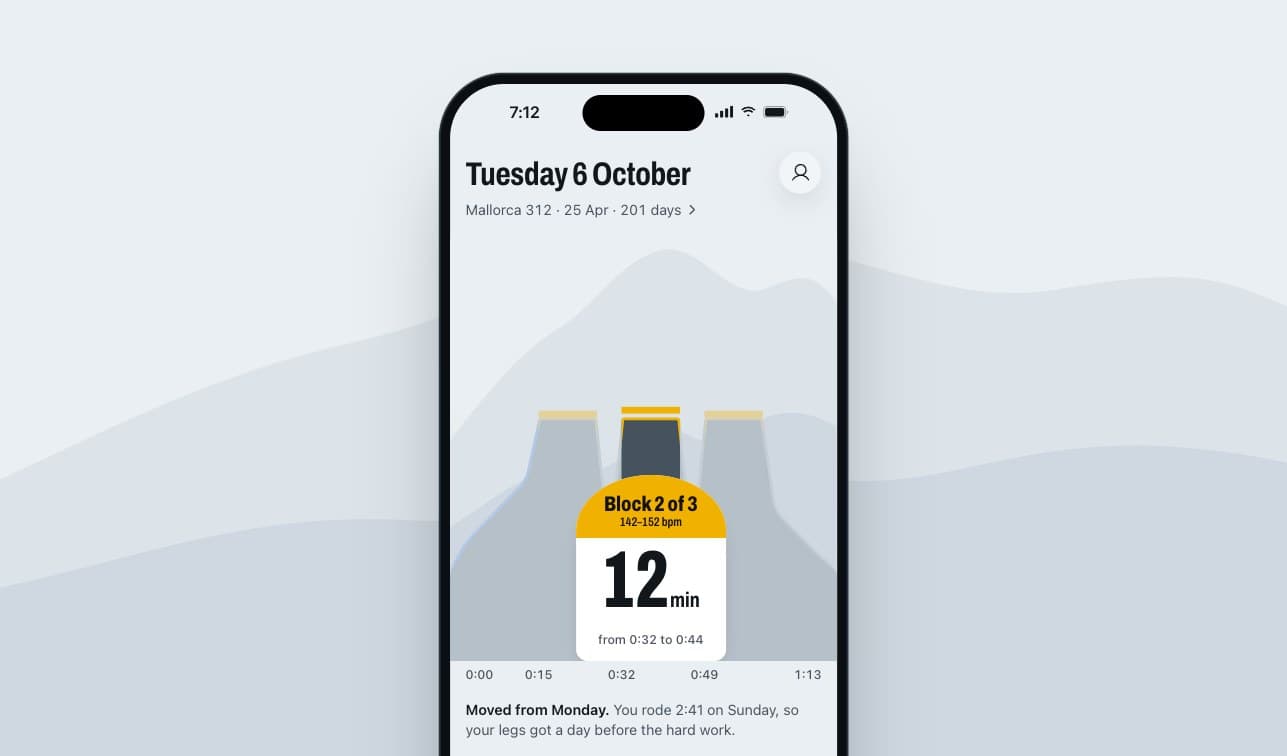
You can train without a power meter and still train with structure. On long, steady efforts, a chest strap does most of what watts would do. It fails on short, hard work and on days when your body isn't itself. Know both sides and heart rate training is a proper method, not a stopgap.
Find your zones without a lab
Heart rate zones are only as good as the number they're built on. The most useful anchor is your lactate threshold heart rate (LTHR): the heart rate you can hold for a hard, steady effort of about an hour. You can get a good estimate of it on the road.
The 30-minute field test
This is Joe Friel's test. It's simple, and easy to spoil.
- Warm up for 15–20 minutes. Mostly easy, with two or three 1-minute efforts that build to hard, then a few minutes easy. Start the test warm, not tired.
- Ride 30 minutes alone, as hard as you can hold evenly. Not in a group, not on a wheel: sheltering lowers your heart rate and the number comes out wrong.
- Press lap at 10 minutes. Your LTHR is the average heart rate of the last 20 minutes.
Pacing is the whole test. Most people start too hard, blow up after ten minutes and crawl to the end, which gives an LTHR that's too low. The first five minutes should feel controlled, almost too easy. From halfway it should take real effort to hold the pace, and in the last five minutes you lift if there's anything left.
The road matters. A steady climb of about 30 minutes is ideal: it's easier to keep the pressure on uphill. Otherwise, a flat road with no junctions or lights. Avoid descents and stops. Every time you freewheel, heart rate drops and drags the average down.
What else ruins it:
- Fatigue. Test after a day or two of easy riding, not the day after a hard session. A tired body often can't push its heart rate up.
- Heat. On a hot day heart rate runs higher for the same effort, and you'll set your threshold too high.
- A wrist sensor. Optical wrist sensors are unreliable on the bike. Use a chest strap.
- Indoors vs outdoors. On a trainer without a strong fan, heart rate tends to run higher. If you mostly ride indoors, test indoors with a fan and use that number there.
- Your running zones. Threshold heart rate on a run isn't the same as on the bike. Test each sport separately.
Retest every six to eight weeks, or sooner if your zones stop matching how the efforts feel.
Why 220 − age is a poor anchor
220 − age describes an average across a large group of people. Individuals scatter widely around it, above and below, and the formula can't tell you which side you're on. Two healthy 45-year-olds can have very different maximum heart rates. Build zones on the wrong maximum and every zone is off.
Tanaka's formula, 208 − 0.7 × age, fits measured averages better, especially for older athletes, but it's still an estimate of an average. Use a formula only if you have nothing else, and replace it once you've done the field test.
Even a correct maximum says little about where your threshold sits, because that depends on how trained you are. LTHR measures that point directly.
Cycling heart rate zones as % of LTHR
These are Andrew Coggan's heart rate zones. The example column is for an LTHR of 165 bpm.
| Zone | % of LTHR | LTHR 165 | Used for |
|---|---|---|---|
| Z1 Recovery | below 68% | below 112 | Recovery spins, cool-downs |
| Z2 Endurance | 69–83% | 114–137 | Long steady rides, most of your week |
| Z3 Tempo | 84–94% | 139–155 | Steady, controlled pressure |
| Z4 Threshold | 95–105% | 157–173 | Hard intervals of 8–20 minutes |
| Z5 VO2max | above 105% | above 173 | Short, very hard efforts |
You won't train Z5 by heart rate. The next section explains why.
What heart rate is good at, and where it misleads you
Heart rate is good at steady efforts: endurance rides, tempo, sweet spot, and threshold intervals of eight minutes or more. They last long enough for heart rate to settle and show clearly whether you're on target. It's also good at catching drift. If your heart rate creeps up in the third hour while your speed stays the same, you're tiring, overheating or under-drinking.
Everything else is shakier. The usual problems, and what to do about each:
Lag. Heart rate takes several minutes to catch up with a change in effort. In a 1-minute effort it's still climbing when you stop, and the peak comes after. Fix: ride short efforts by feel (RPE, rate of perceived exertion, on a 1–10 scale), and judge longer intervals by their final minutes, not their first.
Heat. On a hot day heart rate runs higher for the same effort and keeps drifting up. On endurance rides, keep your ceiling and ride slower: heat is extra stress, so that's the right call. In intervals you'll hit the top of the zone sooner. Drop a rep rather than force it.
Caffeine and stress. Both can nudge heart rate up. Fix: keep tests and key sessions consistent. Same coffee, similar time of day.
Fatigue. This one catches people out. When you're properly cooked, heart rate often won't climb: the effort feels brutal and the number stays low. The instinct is to push harder to reach the zone. Don't. A heart rate that won't come up on an interval day is a reason to ride home easy. The opposite happens too: after a bad night, or with a cold coming on, heart rate sits several beats higher than usual on an easy ride. Same response.
The rule: when heart rate and feel disagree, believe whichever one tells you to back off.
Sessions written for heart rate
Targets are for an LTHR of 165. Use the percentages for yours. For how these fit into a week, see cycling training plan.
1. Endurance ride with a ceiling
2–3 hours below 83% of LTHR (137 bpm).
The ceiling is the session. On climbs and into the wind, shift down and let the speed drop rather than go over it. It feels slow at first. After some weeks you'll ride faster under the same ceiling, which is the point.
2. Tempo: 3 × 12 minutes
Warm up 15 min. Then 3 × 12 min at 85–92% of LTHR (140–152 bpm), 4 min easy between. Cool down 10 min.
Start each block by feel, at the effort you settled into last time, rather than chasing the number: heart rate needs two or three minutes to get there. From then on, ride to heart rate. In the last block it will creep up a few beats. That's drift, not a reason to ease off much.
3. Threshold: 4 × 8 minutes, judged at the end
Warm up 15–20 min. Then 4 × 8 min, 4 min easy between.
For the first three or four minutes, ignore the screen and ride a hard, even effort, around 7–8 out of 10. What counts is the last three minutes: heart rate should sit at 95–102% of LTHR (157–168 bpm). If it goes well past 105% before the end, you started too hard. If it never gets above 95% on a rested day, push harder on the next rep.
4. Short hill repeats, on feel
Warm up 20 min. Then 6 × 90 seconds up a 5–8% hill, hard but even, around 8–9 out of 10. Roll back down; 3 minutes recovery in total.
Don't look at heart rate during the effort: it's still rising as you crest. Pace them so the last is as strong as the first. If your time on the hill drops off clearly, stop there.
If you'd rather not work out these targets yourself each time, Watt4 plans on heart rate when there's no power meter, and sends each session as a structured workout to your Garmin or Wahoo.
Tracking progress without watts
Without power you lose a clean fitness number, but two simple checks cover most of it.
Same climb, same heart rate. Pick a climb that takes 8–15 minutes. Every few weeks, ride it at a fixed heart rate, say 90% of LTHR (149 bpm at 165), and note your time. A climb beats a flat road because wind matters less. If the time drops at the same heart rate, you're fitter. Heat, wind and fatigue move the result, so watch the trend over several attempts.
Aerobic decoupling. On a long, steady ride, compare the first half with the second. Joe Friel's rule of thumb: if your output per heartbeat drops by more than about 5% from the first half to the second, your endurance isn't yet solid for that duration.
Without power, use speed. That only works on a flat route ridden the same way in both halves, such as the same loop twice. Example: first hour at 28 km/h and 130 bpm, second hour at 27 km/h and 134 bpm. 28 ÷ 130 = 0.215 and 27 ÷ 134 = 0.201, a drop of about 6.5%. The same ride a month later coming in under 5% means your base is building.
If you ride indoors on a smart trainer, you probably have power there already: most smart trainers measure it.
When a power meter is really worth buying
Honestly: for endurance riding and long intervals, heart rate and feel get you most of the way. A power meter doesn't make you fitter. It makes measuring easier.
It's worth the money when:
- you do a lot of short, hard intervals and want to know whether you actually hit them;
- you ride time trials or long climbs and need to pace from the first minute, before heart rate catches up;
- you want to track training load precisely across a season;
- heart rate keeps misleading you because of heat, fatigue or a flaky sensor.
If you mostly ride steady, a few hours a week, buy a good chest strap first and learn to ride by it.