Cycling Training Plan: 8 Weeks on 5 to 8 Hours a Week
A full 8-week schedule with real sessions in power and heart rate, and clear rules for keeping it alive when a week goes wrong.
Also available in: NederlandsFrançaisEspañolItaliano
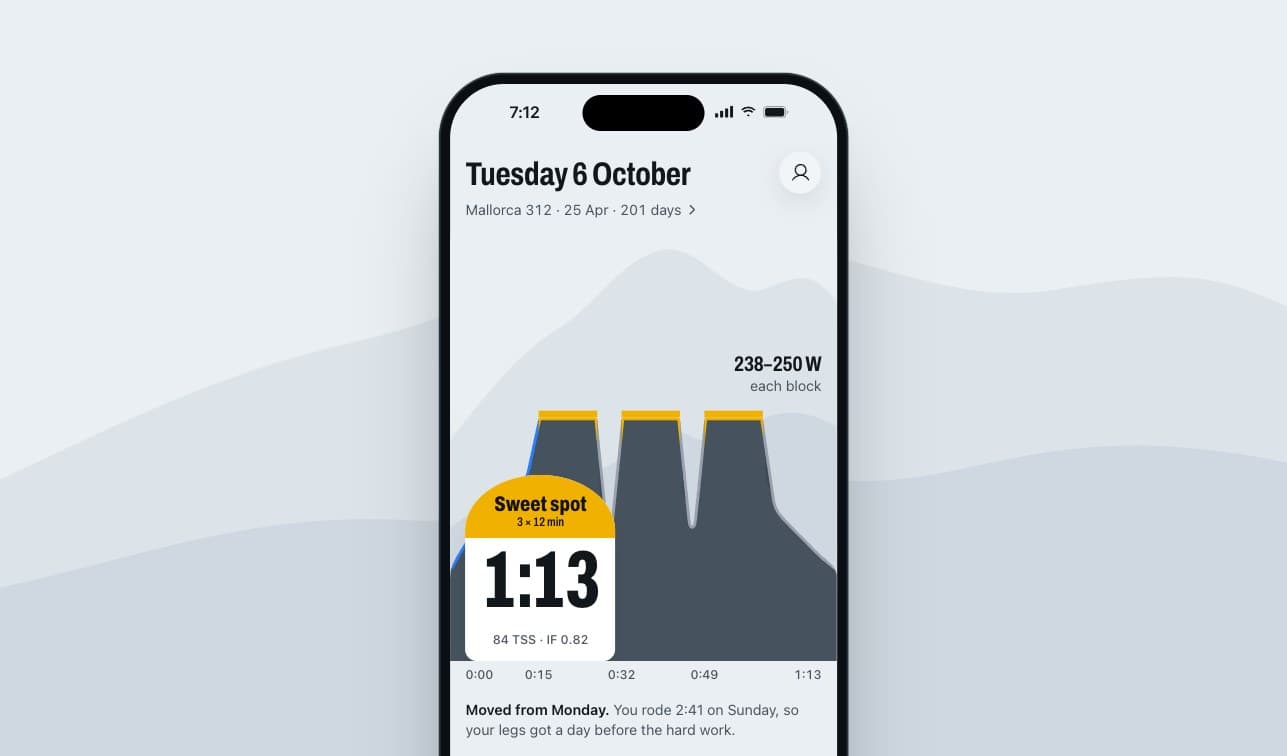
A cycling training plan for 5 to 8 hours a week needs three sessions you protect and two you can drop. Below is the full 8-week schedule, session by session. After that comes the part most plans leave out: what to do when week three goes sideways.
Before week 1: two numbers
Every session is written as a percentage of FTP, with the heart-rate equivalent as a percentage of your threshold heart rate (LTHR). You need at least one of the two.
- FTP: ride 20 minutes as hard as you can hold evenly and take 95% of the average power.
- LTHR: Joe Friel's field test. Ride 30 minutes solo, all out, and take the average heart rate of the last 20 minutes.
The example rider here has an FTP of 250 W and an LTHR of 165 bpm; swap in your own. Without a power meter, read training on heart rate first.
Two warnings. Heart rate lags several minutes behind a change in effort, so it reads low at the start of every interval; don't chase it. It also drifts upward in heat and on long rides, so in hour three the same power shows a higher number.
The weekly template
Three sessions carry the plan. The other two add volume when you have the time.
- Monday: rest.
- Tuesday, core: threshold or sweet spot, 60–75 min. 15 min warm-up, the intervals, 10 min cool-down.
- Wednesday, optional: easy ride, 45–60 min in zone 2, or rest.
- Thursday, core: VO2max intervals, 60 min.
- Friday: rest.
- Saturday, core: long ride, 2h30–3h30 in zone 2. A club ride counts if you can sit in and stay out of the attacks.
- Sunday, optional: endurance, 1h30–2h, with tempo blocks from week 2.
The core takes about 4h45 in week 1 and close to 6 hours in week 7. With both optional rides you're at 7 to 8 hours; if 8 is your ceiling, skip Wednesday in weeks 6 and 7. On 5 hours, ride only the core and cap the long ride at 2h30.
The intensities, for the example rider:
- Zone 2 (endurance): 56–75% FTP (140–188 W), HR 69–83% LTHR (114–137 bpm). You can talk in full sentences.
- Tempo: 76–90% FTP (190–225 W), HR 84–94% LTHR (139–155 bpm).
- Sweet spot: 88–93% FTP (220–233 W), HR around 92–97% LTHR (152–160 bpm), reached towards the end of each block.
- Threshold: 95–100% FTP (238–250 W), HR around 97–102% LTHR (160–168 bpm).
- VO2max: 106–115% FTP (265–288 W). A 3-minute interval is over before heart rate catches up, so ride these on power or feel: the last rep should be a struggle you still finish.
Why this shape? Two hard days, at least one easy day between them, and everything else easy. That puts roughly 80% of your time at low intensity, in line with what Stephen Seiler observed in endurance athletes. The grey middle, where most amateurs spend their whole week, only shows up in the Sunday tempo blocks, on purpose.
The 8 weeks
Weeks 1–3: build
- Week 1. Tue: 3 × 10 min sweet spot, 5 min easy between. Thu: 5 × 3 min at 108–115%, 3 min easy. Sat: 2h30. Sun: 1h30 zone 2.
- Week 2. Tue: 3 × 12 min sweet spot, 4 min easy. Thu: 6 × 3 min at 108–115%, 3 min easy. Sat: 2h45. Sun: 1h30 with 2 × 10 min tempo.
- Week 3. Tue: 2 × 20 min sweet spot, 5 min easy. Thu: 5 × 4 min at 106–112%, 4 min easy. Sat: 3h. Sun: 1h45 with 2 × 15 min tempo.
Week 4: easier
Tue: 45 min zone 2 with 3 × 1 min brisk. Thu: the 20-minute benchmark (see below). Sat: 2h easy. Sun: off, or 1h easy.
Volume drops to about 60% of week 3, with a little intensity left in so your legs don't go flat.
The easier fourth week is a coaching convention, not science. Three up and one down fits a calendar month, and many amateurs manage about three weeks of rising load before the sessions start to suffer. Over 50, sleeping badly or in a demanding job? Two up and one down works too. What matters is that fatigue drops regularly, because only then can you see whether you've improved.
Weeks 5–7: build again, closer to threshold
- Week 5. Tue: 3 × 10 min threshold (95–100%), 5 min easy. Thu: 5 × 4 min at 108–115%, 4 min easy. Sat: 3h. Sun: 1h45 with 2 × 15 min tempo.
- Week 6. Tue: 3 × 12 min threshold, 5 min easy. Thu: 4 × 5 min at 106–110%, 5 min easy. Sat: 3h15. Sun: 2h with 2 × 20 min tempo.
- Week 7. Tue: 2 × 20 min at 92–97%, 5 min easy. Thu: 6 × 4 min at 106–112%, 4 min easy. Sat: 3h30. Sun: 2h with 2 × 20 min tempo.
Week 8: easier, then test or ride your event
Tue: 2 × 8 min threshold, 5 min easy. Thu: 3 × 3 min at 110% if you have an event at the weekend, otherwise the 20-minute benchmark. Sat: 2h easy, or the event. Sun: off, or 1h easy.
One thing changes at a time: in weeks 1–3 the time at intensity grows (30, 36, 40 minutes of sweet spot), in weeks 5–7 the intensity rises. The long ride grows by 15 minutes a week at most. If you can't finish the reps in week 3 or 7, even at the bottom of the range, repeat the previous week. That's the plan fitting your level, not you failing it.
When the schedule breaks
It will. Here are the rules for the usual ways.
Know what to drop first. When something has to go, drop Wednesday, then Sunday, then Thursday. Keep Tuesday and the long ride as long as you can. On this volume, threshold work and long aerobic rides do most of the work for a rider preparing for a sportive or fast club rides. VO2max work sharpens, but a week without it costs little.
Never two hard days in a row. A hard day is an interval session, a race, or a club ride where you spent real time above tempo. Leave at least one easy day between two of them. Stacking them doesn't double the gain: the second session is ridden worse and the fatigue follows you into the weekend.
A missed Tuesday. If Wednesday is free, ride Tuesday's session on Wednesday and make Thursday an easy hour. If it isn't, let it go and ride Thursday as planned. Don't bolt the missed intervals onto Thursday or Saturday. A missed session is gone, and that's fine.
The club ride that turned into a race. Someone goes on the first climb and the easy Saturday is a race. Count it as a hard day: Sunday becomes an easy hour or rest, and if your legs are still heavy on Tuesday, swap Tuesday and Wednesday. If your club ride is always fast, stop calling it endurance. Plan it as one of your two hard sessions and ride Thursday easy instead of doing intervals.
A busy week where you barely rode. If work, not illness, cut the week to less than half, call it your easier week and carry on with the next build week. Your legs are rested, which is what the easier week was for.
Three or more days off. First day back: 60–90 min in zone 2, nothing else. Then pick up the plan where the calendar is, but ride the first interval session at the previous week's level. After a full week or more off, repeat the last week you completed.
Illness. With a fever, body aches or anything in your chest, don't ride. A common rule of thumb: symptoms only above the neck, like a runny nose, may allow an easy spin; anything below the neck means rest. Once you're better, ride easy for about as many days as you were ill before the first interval session, then restart with the last week you completed. Your heart rate may sit higher than usual at the same power for a few days; if it doesn't settle, give it more time. If you're unsure, ask a doctor, not the plan.
The event date is fixed and you've lost time. Don't cut the easier week before the event. Cut from the middle: drop a build week and keep the last 7–10 days light.
Doing this by hand works; it's what a coach does every week. If you'd rather not, Watt4 reads your Strava, Garmin or Wahoo history, re-plans the week when you tell it about travel, illness or a club ride you won't skip, and tells you what the change cost.
How to tell whether it's working
Feeling tired proves nothing. Use three checks you can repeat under the same conditions.
1. The 20-minute benchmark. Before week 1, in week 4 and in week 8. Same climb or same trainer, same time of day, after a rest day. Pace it evenly: the first five minutes should feel too easy. With power, 95% of the average is your new FTP; update your zones. Without power, note your time and average heart rate. Wind changes climb times, so the trainer or a sheltered climb is cleaner.
2. Heart rate at a fixed power. Once a week, after warming up on an easy ride, hold the same power for 20 minutes, say 65% of FTP (163 W for the example rider), and note the average heart rate. If it drops by a few beats over the weeks, your aerobic engine is improving. No power meter? A smart trainer's reading may not be exact, but it is usually consistent enough to compare with itself. A hot room pushes heart rate up, so keep the conditions similar.
3. The last hour of the long ride. In week 1 the last 30 minutes of 2h30 may be a grind. By week 7 you should ride 3h30 and still hold zone 2 power at the end. Compare heart rate in the first and last hour at similar power: a big rise means that duration is still at your limit.
If nothing moves, check three things before blaming the plan. Were the easy rides easy? Did you ride most Tuesday sessions? Did the easier weeks happen? If all three are yes and the benchmark is flat after eight weeks, change the stimulus: more volume if you can find it, or a block with more threshold work.
After week 8, start again at week 1 with your new FTP.