How Many Hours a Week Should You Train for Cycling?
It depends on what you're training for. Here are honest hour ranges by goal, how to spend them, and why your long ride matters more than your weekly total.
Also available in: NederlandsFrançaisEspañolItaliano
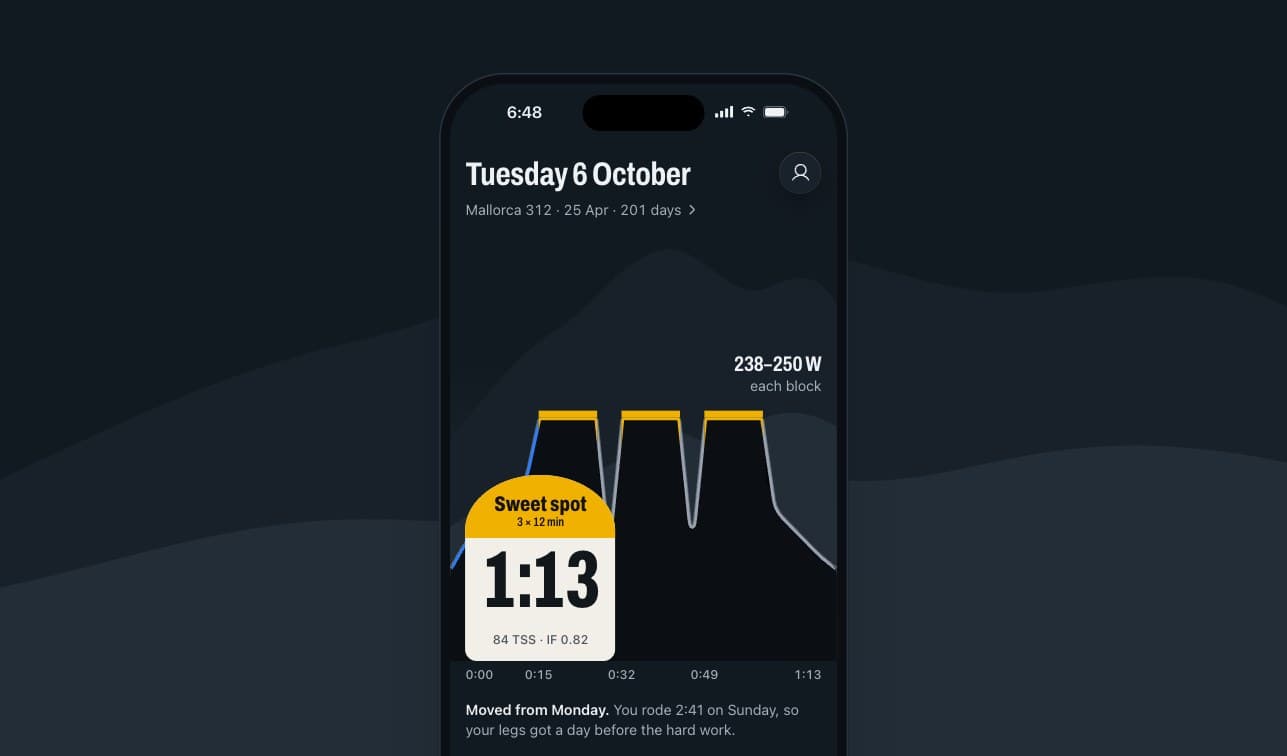
How many hours a week you should train depends on what you're training for. Here is the short answer by goal. These are coaching rules of thumb, not numbers from a study, and they assume you ride most weeks of the year and want to improve, not just hold on.
- Staying fit and enjoying the club ride: 3–5 hours a week.
- A first 100 km, or a sportive of that length: 5–7 hours, with one ride a week building to around 3 hours.
- A hilly sportive of 150 km or more, or a gravel event of 5+ hours: 7–10 hours, with the long ride building to 4–5 hours.
- Racing as an amateur: 8–12 hours in the build-up, sometimes more for long road races. If you mostly race criteriums, you can do well on less, as long as the sessions are sharp.
With fewer hours you can usually still finish. You'll just suffer more in the last part, which is exactly what those hours are for.
The long ride matters more than the weekly total
Two riders each train 7 hours a week. One does six rides of 70 minutes. The other does three hours of weekday sessions and a 4-hour Saturday. Same total. For a 150 km sportive, the second rider is far better prepared.
What goes wrong in a long event is rarely your threshold power. It's the things that only show up after hours in the saddle: power that fades in the final third, fuelling you never practised, a lower back or a saddle that becomes a problem after three hours, a first climb ridden too hard that you pay for on the fourth. You only train those by being out there for a long time.
A useful rule of thumb: let your longest ride build to roughly two-thirds to three-quarters of the time you expect to spend on the event.
- A 100 km sportive you'll ride in about 4 hours: build the long ride to 2.5–3 hours.
- A 6-hour gravel event: build to 4–4.5 hours.
- An 8-hour mountain sportive: build to around 5 hours, and stop there.
Why not ride the full duration in training? On the day you're rested, in a group, eating to a plan and carried by adrenaline. A training ride as long as the event costs several days of recovery every time, taken from the rest of your week. Two-thirds to three-quarters gets you most of the adaptation at a fraction of the cost.
So put the long ride in first and fit the rest around it. The weekly total is whatever is left.
How to spend 4, 6, 8 or 10+ hours
Whatever the volume, the shape stays the same: most riding easy, a little riding hard, and not much in between. Stephen Seiler observed that endurance athletes do roughly 80% of their training at low intensity. For a cyclist, easy means Zone 2: 56–75% of FTP, or 69–83% of your threshold heart rate if you ride on heart rate. Hard means two quality sessions a week, at most.
What changes as the hours go up is not the number of hard sessions. It's how much easy riding surrounds them, and how long the long ride gets.
4 hours
- Tuesday, 1 hour: 3 × 10 min at 88–93% FTP, 5 min easy between.
- Thursday, 1 hour: 5 × 3 min at 110–115% FTP, 3 min easy between.
- Weekend, 2 hours: steady Zone 2.
At four hours the 80/20 split bends: two of three rides contain intensity. The total load is low enough to recover from, and one more easy hour would add little. What doesn't work is riding everything medium-hard. The article on raising your FTP goes deeper into making a short week count.
6 hours
- Tuesday, 1 hour: intervals, as above.
- Wednesday, 1 hour: easy.
- Saturday, 3 hours: Zone 2, with 2 × 15 min at tempo (76–90% FTP) in the second half.
- Sunday, 1 hour: easy.
The long ride is now long enough for a 100 km event. The second quality session moves into it as tempo, because two interval days plus a 3-hour ride would leave almost nothing easy.
8 hours
- Tuesday, 1.5 hours: 2 × 20 min at 88–93% FTP, 10 min easy between.
- Wednesday, 1 hour: easy.
- Thursday, 1.5 hours: 5 × 4 min at 106–115% FTP, 4 min easy between.
- Saturday, 4 hours: Zone 2, eating and drinking the way you will on event day.
Two real quality sessions, a long ride that's long enough for a hilly sportive, and one easy ride to hold the week together. The intervals get longer, not harder.
10 hours and more
- Tuesday, 1.5 hours: threshold, for example 3 × 12 min at 95–100% FTP.
- Wednesday, 1 hour: easy.
- Thursday, 1.5 hours: short hard efforts above threshold, or race-specific work.
- Friday: 45 min very easy, or off.
- Saturday, 4 hours: long Zone 2 ride.
- Sunday, 2–2.5 hours: Zone 2 on tired legs.
Above 8 hours, almost every extra hour should be easy. A third hard day is the quickest way to make the other two worse. The back-to-back weekend is where 10 hours earns its keep: Sunday with Saturday still in your legs feels a lot like the last two hours of a long event.
When the week shrinks, cut in this order
- Extra easy rides and recovery spins.
- The length of the easy rides that remain.
- The second quality session.
- Then choose between the last quality session and the long ride, depending on your goal. Long event: protect the long ride. Racing or short events: protect the intensity.
Don't move the missed hours to the weekend. Five hours crammed into Saturday and Sunday after a tired week mostly buys fatigue. A short week is a short week, and the next one carries on.
This juggling is tedious to redo every Monday. Watt4 reads your ride history, plans the week around the hours you actually have, and re-plans when one of them disappears. Give it an event and it plans back from that date.
Why kilometres are a poor measure
"How many kilometres a week?" is the question most riders ask, and it's the wrong unit. The same 60 km can be very different loads:
- Wind. 30 km out into a headwind and 30 km home with it behind you costs more than the average speed suggests.
- Hills. 60 km with 1,000 m of climbing takes longer and costs more than 60 km along a canal.
- Surface. On gravel you ride slower for the same effort, so a gravel ride piles up hours, not kilometres.
- Group or solo. On the wheels in a club ride you need far less power than alone at the same speed.
Count time instead. It's what your body feels, and what you have to find in your week.
If you have a power meter, add load. Training Stress Score combines duration and intensity: TSS = hours × IF² × 100, where IF (intensity factor) is your normalized power divided by your FTP. A 3-hour Zone 2 ride at IF 0.70 gives 3 × 0.49 × 100 = 147 TSS. A 1-hour interval session at IF 0.80 gives 1 × 0.64 × 100 = 64. An hour at exactly your FTP (IF 1.00) is 100 by definition. If your hours stay the same but your weekly TSS climbs, your load is still going up. Without a power meter, time in each heart rate zone does a similar job.
If you still want a distance, take your own average speed on an easy solo ride and multiply. At 27 km/h, 6 hours is about 160 km. But plan in hours.
How fast to add volume
Add hours slowly, and add them as easy riding. A common coaching convention:
- Add half an hour to an hour per week, for three weeks.
- Then ride an easier week at about two-thirds of that volume.
- Lengthen the long ride by 20–30 minutes at a time.
The often-quoted "10% per week" rule is a convention too, not a law. What matters is that each step is small enough to recover from within the week.
Signs you're doing too much
Take these seriously, especially when two or more show up together:
- Performance going stale. The same intervals feel harder at the same watts, or numbers that were easy two weeks ago are now out of reach.
- A high resting heart rate. If you measure it in the morning, several days in a row above your usual value are worth noticing. One high reading after a bad night means little.
- Motivation dropping. You find reasons not to ride, or the easy rides start to feel like a chore.
- A heart rate that won't rise. Your legs are burning in an interval, but your heart rate stays well below where it normally goes at that effort. Heart rate lags behind effort, so judge this on efforts of several minutes, not 30-second sprints. On a longer interval it's a classic sign of accumulated fatigue, and a cue to stop the session.
What to do: two or three easy days, then a session you know well. If it goes fine, carry on at the previous volume, not the higher one. If not, take a full easy week before adding anything.